
Survey Note: Detailed Analysis of Rocket Mortgage's Acquisition of RedFin
Published on: March 10, 2025, at 05:43 PM EDT
Rocket Companies, the parent company of Rocket Mortgage, announced its acquisition of RedFin, a leading digital real estate brokerage, in an all-stock transaction valued at $1.75 billion. This move, offering RedFin shareholders 0.7926 Rocket shares per RedFin share at a 63% premium over RedFin's 30-day average price, raises the question of why Rocket Mortgage would pay such a premium for a company that has been consistently losing money. Below, we delve into the strategic rationale, financial context, and market implications to understand this decision.
Background and Announcement
The announcement, made earlier today, was covered extensively in financial and tech news outlets. According to a press release from Rocket Companies (Rocket Companies Press Release: Detailed Announcement), the deal values RedFin at $12.50 per share, representing a significant premium over its recent stock price. This acquisition aligns with Rocket Companies' strategy to expand its presence in the residential real estate market, leveraging RedFin's established brand and user base.RedFin, founded in 2004 and headquartered in Seattle, operates a top-three home search platform with over 1 million for-sale and rental listings and employs more than 2,200 agents. The company's platform attracts nearly 50 million monthly visitors, making it a valuable asset for driving mortgage business. Rocket Companies, based in Detroit, is known for its fintech platform, including brands like Rocket Mortgage, Rocket Money, and Rocket Loans, and is the largest mortgage lender in the U.S.Financial Performance of RedFin
The financial data provided for RedFin, covering the years 2021 to 2024, reveals a company facing profitability challenges but with significant revenue potential. Below is a detailed breakdown of RedFin's income statement, extracted from the attached financials: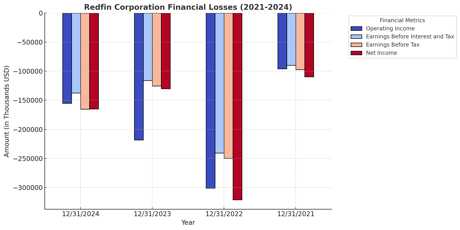
Analysis of these figures shows that RedFin has been consistently unprofitable, with net losses ranging from approximately $110 million in 2021 to a peak of $321 million in 2022. Revenue, however, saw a slight increase from 2021's $1,058,638,000 to $1,099,574,000 in 2022, then dropped to $976,672,000 in 2023 before recovering slightly to $1,042,979,000 in 2024. This fluctuation suggests volatility in the real estate market, with 2022 likely benefiting from a stable housing market, followed by a downturn in 2023.
Gross profit, as reported, ranged from $309,119,000 in 2022 to $393,219,000 in 2021, but there appears to be a discrepancy in the calculation, as standard accounting would suggest higher gross profit based on revenue and cost of revenue. This may indicate that "Cost of Revenue" includes additional expenses not typically part of the cost of goods sold, or there may be a reporting error in the provided data. Nonetheless, operating income remained negative, with losses decreasing from $300,857,000 in 2022 to $155,255,000 in 2024, indicating some improvement in operational efficiency.
Strategic Rationale and Expected Benefits
The acquisition's rationale, as detailed in various news reports, centers on leveraging RedFin's user base and technology to enhance Rocket Mortgage's mortgage origination business. According to TechCrunch Article: Acquisition Overview, the combined entity will pool strengths in home search services and financing, aiming to make the home-buying process "magical" by integrating services like home searches, tours, and pre-qualifications for loans. Rocket Companies CEO Varun Krishna emphasized a "unified vision of a better way to buy and sell homes," focusing on removing friction and reducing costs (Rocket Companies Press Release: Detailed Announcement).RedFin's nearly 50 million monthly visitors, as noted in GeekWire Article: Market Reaction and Competition, provide a significant opportunity for Rocket Mortgage to connect these users with its financing products, potentially achieving over $200 million in run-rate synergies by 2027, including $140 million in cost synergies and $60 million in revenue synergies (CNBC Article: Synergies and Deal Details). This integration is expected to boost Rocket Mortgage's share in purchase mortgage originations, as suggested by RBC Capital Markets analysts (Bloomberg Article: Analyst Insights). Additionally, both companies emphasize the use of AI to enhance the customer experience, from home searches to financing and beyond, aiming to create a more connected, tech-driven platform for finding and financing homes. Rocket's mortgage market saw an 8% growth in 2024, further supporting the strategic timing of this acquisition.The deal offers RedFin shareholders 0.7926 Rocket shares per RedFin share, representing a 63% premium over RedFin's 30-day average price, reflecting the value placed on RedFin's brand and user base despite its unprofitability.
Market Reaction and Analyst Concerns
The market reaction has been mixed, with RedFin's shares surging by 70-80% on the announcement day, reflecting investor approval of the premium offered ($12.50 per share compared to a recent close around $5.83, calculated from a 75% rise to $10.20). However, Rocket Companies' stock fell by 10-14%, indicating investor concerns about the deal's cost and integration risks. Analyst reactions, as seen in GuruFocus Article: Investor Concerns, highlight worries about RedFin's exposure to a struggling real estate market, with challenges like economic uncertainty and unaffordable home prices leading to increased purchase cancellations. RedFin's recent layoffs of 450 employees and downside Q1 guidance further fuel these concerns, though Rocket Companies sees potential in RedFin's traffic to boost its services.Potential Implications and Risks
The merger intensifies competition with other real estate giants like Zillow and CoStar, as noted in GeekWire Article: Market Reaction and Competition. For RedFin, the acquisition offers a chance to leverage Rocket's resources to improve profitability, with RedFin CEO Glenn Kelman continuing to lead and the brand maintaining its identity. However, the integration of two companies with different operational models (RedFin's brokerage focus versus Rocket's lending focus) may pose challenges, particularly given RedFin's historical struggles to turn a profit.Conclusion
In summary, Rocket Mortgage's acquisition of RedFin on March 10, 2025, is a strategic move to enhance its service offerings by leveraging RedFin's user base and brand, despite RedFin's financial challenges. The 63% premium reflects the potential for synergies and improved home-buying experiences, with a focus on AI-driven innovation and a significant user base. However, investor concerns and market volatility highlight the complexities involved. This merger could redefine the real estate and mortgage landscape, pending successful execution and market acceptance.Key Citations