


By Brenden Rendo, Realtor · Updated October 14, 2026
On November 3 you will be asked to approve or reject Amendment 3, which would raise the homestead exemption for every non-school property tax levy to $150,000 in 2027 and $250,000 in 2028. I am not going to tell you how to vote. What I can do is open the actual documents, pull current Stellar MLS data, and run the arithmetic for real households in Orange, Seminole, Lake and Volusia counties at the millage rates those counties adopted three weeks ago. Below is what I found, with every figure labeled by who produced it, when, and what it measures.
- Amendment 3 raises the non-school homestead exemption to $150,000 in 2027 and $250,000 in 2028, indexed after that, and cuts the non-homestead assessment cap from 10% to 5%. It needs 60 percent to pass and takes effect January 1, 2027.
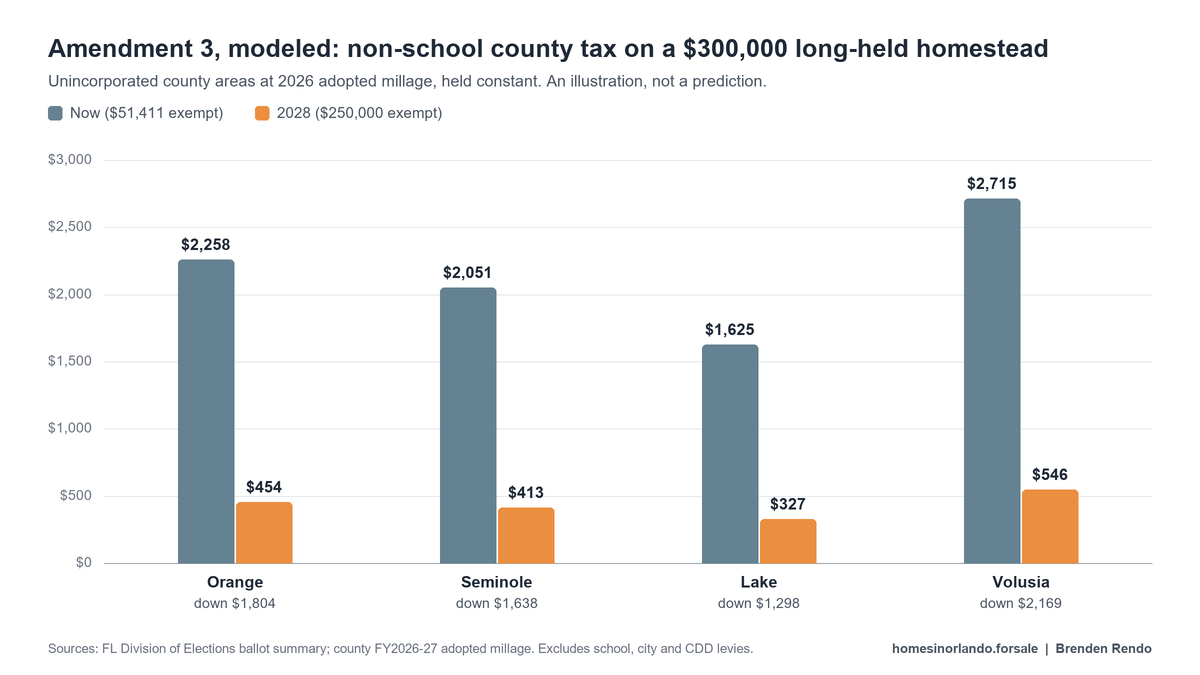
- At 2026 adopted county millage, a long-held homestead assessed at $300,000 would see its non-school county tax drop by a modeled $1,804 in Orange, $2,169 in Volusia, $1,638 in Seminole and $1,298 in Lake by 2028. These are illustrations at today's rates, not predictions.
- The Revenue Estimating Conference puts the recurring cut at $781.1M in the Orange county area, $355.1M in Volusia, $240.8M in Lake and $230.1M in Seminole, counting every local non-school taxing authority in each county.
- Nothing changes on the school portion, and CDD and other non-ad-valorem assessments are untouched. On a Stellar MLS pull dated October 13, 2026, CDD-flagged share of active single-family listings runs 18.13% in Lake, 7.23% in Orange, 4.04% in Volusia and 0.39% in Seminole.
- Any reduction would first appear on November 2027 tax bills, and only if local millage, fees and assessments do not move to replace the revenue. Nobody, including me, can promise you a dollar of savings.
What the ballot actually says, word for word
I pulled the ballot summary from the Florida Division of Elections initiative database on October 13, 2026. The title was rewritten in August after a Leon County Circuit Court ruling, so older summaries circulating on social media are not the text you will see. The summary does four things.
- It raises the homestead exemption, for all non-school taxes, to $150,000 in 2027 and $250,000 in 2028, with inflation adjustment after that.
- It reduces the annual cap on assessment increases for non-homestead property from 10% to 5%.
- It requires counties and municipalities to use property taxes solely for public safety, education and schools, infrastructure, natural resources, bond debt service, retirement benefits for employees, and operations and administration.
- It takes effect January 1, 2027.
One sentence in that summary gets paraphrased wrong constantly, so here it is verbatim: "Persons who are not Florida residents on December 31, 2026, will receive the existing homestead exemption upon qualifying for a homestead exemption, with the increased homestead exemption beginning with the fifth year of exemption, to the extent permitted by the U.S. Constitution."
Read that against the state's own revenue analysis and you find a wrinkle worth knowing. The Revenue Estimating Conference statement on CS/HJR 1F, reviewed July 10, 2026, models the newcomer's second homestead exemption at a flat $50,000 in 2027, indexed after, with the larger exemption arriving in the fifth year. The ballot summary says "the existing homestead exemption." Those are not identical numbers, because the existing non-school exemption for 2026 is $51,411, built from the original $25,000 plus a second, inflation-indexed $26,411. I am flagging the gap rather than papering over it. Confirm your own exemption with your county property appraiser before you plan around either figure.
Four households, four counties, real millage
County general millage is not your whole bill, so I built each county's non-school rate from the levies its board actually adopted for the fiscal year that started October 1, 2026, and I will name them. Unincorporated Orange: countywide 4.4347 plus Fire and EMS MSTU 2.8437 plus the unincorporated Special Tax MSTU 1.8043, for 9.0827 mills. Unincorporated Seminole: countywide 5.3751 plus Fire MSTU 2.7649 plus Roads MSTU 0.1107, for 8.2507 mills. Unincorporated Lake: countywide 5.0254 plus ambulance 0.4629 plus stormwater, parks and roads 0.4957 plus fire rescue 0.4800 plus voter-approved environmental lands debt 0.0719, for 6.5359 mills. Unincorporated Volusia: general fund 3.1007 plus law enforcement 1.5994 plus library 0.3697 plus Volusia Forever 0.2000 plus Volusia ECHO 0.2000 plus Municipal Service District 1.6956 plus Fire Rescue District 3.5990 plus mosquito control 0.1573, for 10.9217 mills.
Those four rates exclude school millage, water management district millage, city millage, and any neighborhood or lake MSTU. If you live inside a city, your own bill carries a city rate on top and your savings would be larger in dollar terms. Everything below holds millage constant at those adopted rates, which is the one assumption most likely to be wrong, since a board that loses revenue can move its rate.
The long-held homesteader, assessed at $300,000 under Save Our Homes
| County area | Non-school mills used | Now, $51,411 exempt | 2027, $150,000 exempt | 2028, $250,000 exempt | Change by 2028 |
|---|---|---|---|---|---|
| Unincorporated Orange | 9.0827 | $2,258 | $1,362 | $454 | minus $1,804 |
| Unincorporated Seminole | 8.2507 | $2,051 | $1,238 | $413 | minus $1,638 |
| Unincorporated Lake | 6.5359 | $1,625 | $980 | $327 | minus $1,298 |
| Unincorporated Volusia | 10.9217 | $2,715 | $1,638 | $546 | minus $2,169 |
Move that same household down to a $200,000 capped assessment and the non-school county tax goes to zero in 2028 in all four counties, because the exemption exceeds the assessed value. Move it up to $400,000 and the 2028 reduction is identical to the $300,000 row, because above $250,000 of assessed value the exemption is fully used either way. That is the shape of this measure: it is worth the most, as a share of the bill, to the modestly assessed long-held homestead, and it stops growing in dollar terms once your assessment passes $250,000.
The recent buyer, the newcomer, and the owner with no exemption
For the recent buyer I used a fresh Stellar MLS pull of single-family closings in each county over the 90 days through October 13, 2026, and assumed assessment lands near the sale price, which is roughly what happens when a homestead resets. Condominiums are reported separately and never mixed in. The newcomer column models someone who was not a Florida resident on December 31, 2026, using the $50,000 non-school exemption from the July 10 state analysis. The last column is a landlord or second-home owner with no exemption at all, who gets only the tighter 5% assessment cap.
| County | Median 90-day closed single-family price | Buyer now | Buyer 2027 | Buyer 2028 | Newcomer 2027 | No exemption |
|---|---|---|---|---|---|---|
| Orange | $505,000 (n=2,928) | $4,120 | $3,224 | $2,316 | $4,133 | $4,587 |
| Seminole | $479,000 (n=1,038) | $3,528 | $2,714 | $1,889 | $3,540 | $3,952 |
| Lake | $395,000 (n=1,706) | $2,246 | $1,601 | $948 | $2,255 | $2,582 |
| Volusia | $355,000 (n=1,490) | $3,316 | $2,239 | $1,147 | $3,331 | $3,877 |
The newcomer number is the one that surprised me. Measured against today's exemption, a 2027 arrival is barely worse off, roughly $13 a year in Orange at the county median. Measured against the neighbor who was a resident on December 31, 2026, the same house carries about $909 more in non-school county tax in Orange in 2027, $826 more in Seminole, $654 more in Lake and $1,092 more in Volusia. The gap roughly doubles in 2028, when the resident's exemption reaches $250,000 and the newcomer's, per the July 10 state analysis, is $51,220: about $1,806 a year in Orange, $1,640 in Seminole, $1,299 in Lake and $2,171 in Volusia, until the newcomer's fifth year of exemption. That is not a penalty on moving here. It is a four-year wait for a benefit the long-term resident gets immediately, and it is the single most misreported piece of this amendment.
Condominium medians over the same 90 days, kept entirely separate: Volusia $350,000 on 244 closings, Lake $260,000 on 33 closings, Orange $175,000 on 436 closings, Seminole $169,500 on 152 closings. Lake's condo count is too thin to build a tax illustration on, which is why I did not.
One more piece of local texture from the same Stellar pull. Among active single-family listings carrying a homestead flag either way, the homesteaded share is 55.58% in Lake, 54.42% in Volusia, 53.34% in Seminole and 47.64% in Orange. Median annual tax on the homesteaded listings runs below the non-homesteaded ones in every county, $5,434.60 against $5,759.50 in Orange, $4,215.00 against $4,403.74 in Seminole, $3,985.89 against $4,278.86 in Lake, and $3,800.38 against $4,167.13 in Volusia. Read that as the current seller's bill on a capped assessment, not as what a buyer will pay after the assessment resets. People confuse those two constantly, and it is an expensive confusion.
What each county and city says it would lose
There are two separate kinds of number circulating and mixing them produces nonsense. The state's Revenue Estimating Conference publishes a county-area row covering every local non-school taxing authority in that county. Individual governments publish their own estimates of their own budgets. Here are both, labeled.
| County area, all local non-school levies | FY 2027-28 | FY 2028-29 | Recurring | County government share of the recurring figure |
|---|---|---|---|---|
| Orange | $270.2M | $501.7M | $781.1M | $565.9M, or 72.45% |
| Volusia | $160.7M | $273.7M | $355.1M | $201.1M, or 56.63% |
| Lake | $98.9M | $177.1M | $240.8M | $157.6M, or 65.45% |
| Seminole | $100.0M | $178.1M | $230.1M | $172.3M, or 74.88% |
All eight REC columns come from the July 10, 2026 statement. Earlier versions of these county rows circulated from a June 12 run and from a June 16 House analysis that repeated it; those are superseded and the numbers are different. The statewide figures on the same table are $4.93B in FY 2027-28, $8.71B in FY 2028-29, and $11.83B recurring. That statewide total covers all 67 counties. The four rows above are the only ones I am claiming, and Osceola, which gets folded into most Orlando-metro aggregates, is not in them.
Now the local estimates, each attributed to whoever produced it.
- Orange County government, on its own Amendment 3 page: approximately $165 million in 2027 and $275 million in 2028. It breaks that into countywide levies at $89M and $157M, fire tax at $46M and $72M, and sheriff tax at $30M and $46M. The same page states that 51 percent of its property tax revenue, about $1.196 billion, funds public safety.
- City of Orlando, on its own budget page: projected revenue loss of $30 million in fiscal year 28 and $50 million in fiscal year 29, with $80 million shown separately as the figure if homestead taxes were eliminated entirely. The city also notes that 60 percent of its residents are renters. The $80 million is a scenario, not a year, and I have seen it quoted as a year.
- The July 10 state analysis, per government, first-year cash: City of Orlando $31.7M, Deltona $12.8M, Daytona Beach $7.7M, Sanford $6.6M, Clermont $5.8M, Altamonte Springs $2.7M. Altamonte Springs also ended Red, Hot and Boom this year citing event size and its own $950,000 cost alongside Amendment 3, so the amendment was one named factor, not the sole cause.
- Volusia County Sheriff Mike Chitwood, reported by News 6 on September 25: his agency could lose $37 million next year.
- Florida TaxWatch, which recommends a No vote in its voter guide, puts the five-year statewide reduction at roughly $45.8 billion and the five-year county-area totals at $2,825.1M for Orange, $1.41B for Volusia, $930.9M for Lake and $913.7M for Seminole, and argues the measure shifts burden onto non-homestead owners.
What does not change on your bill
Pull last November's bill out and look at the lines, because several of them are untouched. The school levy does not change; the state's own adopted impact table shows the school effect at zero in every year. Non-ad-valorem assessments do not change either, which matters more in some of our counties than others. On the October 13 Stellar pull, the CDD-flagged share of active single-family listings is 18.13% in Lake, 7.23% in Orange, 4.04% in Volusia and 0.39% in Seminole. If you are one of the 455 Lake County listings carrying a CDD, that assessment is a separate line and Amendment 3 does not reach it.
Insurance does not run through this amendment at all, and it is moving on its own. The Florida Office of Insurance Regulation Property Insurance Stability Report published in July 2026, using data as of March 31, 2026, puts the average homeowners premium including wind at $3,610 in Orange, $3,545 in Seminole, $2,808 in Volusia and $2,650 in Lake, and reports that the average decreased in 51 counties from the January report. That decline is statewide. In our four counties the same reports show the average roughly flat over those six months, up less than 1% in Orange, Seminole and Lake and slightly down in Volusia, so if you see a comment claiming insurance tripled this year, that is not what the regulator's numbers show.
Timing matters too. The amendment takes effect January 1, 2027, which applies to the 2027 assessment roll. Your bill for that roll arrives in November 2027. Nothing on your bill this November changes either way.
For background on how Save Our Homes caps work and why a long-held homestead and its new buyer pay such different amounts, I wrote that up in Unlocking Tax Benefits: Navigating Florida's Homestead Exemption. For the earlier, separate legislative property tax package and why its details mattered, see the fine print on Florida's property tax plan. And if the reason you have not moved is that your capped assessment and your rate are both too good to give up, that is the subject of the lock-in effect and renovating instead of selling.
What residents are actually arguing about
I ran a 30-day sweep across Reddit, X, YouTube, TikTok, Instagram and prediction markets on October 13 and pulled 91 items. The useful finding is that almost nobody is arguing about whether the exemption cuts homeowner bills. Both sides concede that. The fight is over who fills the hole, and whether renters and recent arrivals get anything.
The yes-side energy online is overwhelmingly about local spending discipline rather than about tax math. A commenter posting as @BBB-p2h on a widely watched Amendment 3 breakdown wrote, verbatim and including the typo: "VOTE YES & make cities cut the "FLUFF" spending ! If Gov. DeSantis can do it for our State , Cites need to follow his example !" That comment drew 30 likes on a video with 630 likes and 214 comments. On X, @4tiffypatrick argued the inflation case on October 13: "Yes… vote yes on amendment 3 #Florida for #FL resident homeowners! It was set at $50,000 in 2008; only raised to $50,722 in 2025 with still no future adjustment for inflation!" I checked that $50,722 against the state's own table, and it is right for the 2025 roll year: $25,000 plus the indexed $25,722.
The no-side energy is concentrated in two places, public safety agencies and renter groups. The clearest renter voice I could attribute came from WFLA on October 12, where Lacey Lingelbach, who rents in downtown St. Petersburg and has been working with the Democratic Socialists of America St. Pete chapter, said: "We get no direct benefit from this amendment." She added: "This doesn't necessarily make landlords have to decrease their rent for us. They're going to want to keep on profiting off of us." That is Tampa Bay, not one of our four counties, and I am labeling it as such, but the argument is identical to what I see in Orlando and Daytona threads.
In the same report, Florida Realtors CEO Margy Grant made the counterargument that the measure reaches rentals through a different door: "It also has a reduction on the cap for taxes on non-homesteaded properties, meaning commercial and rental properties." Whether a lower assessment cap on a rental becomes lower rent is a behavioral question, not an arithmetic one, and I have no data that settles it.
The other recurring theme is the one in the tables above: the five-year residency provision. It is the detail most people get wrong in both directions, and it is the reason I spent so much of this post on the newcomer column.
Where the vote stands and who is paying for the campaigns
Amendment 3 needs 60 percent to pass. The newest statewide survey I could verify is the NBC6 and Telemundo 51 poll conducted by Mason-Dixon from September 28 to October 1, 2026, among 625 registered voters who said they were likely to vote, with a margin of error of no more than 4 points. It found 55 percent support, 26 percent opposed and 19 percent undecided. Among supporters, 49 percent named high property taxes as their main reason; among opponents, 55 percent cited concern about cuts to local services. An earlier St. Pete Polls survey of 913 likely voters taken September 15 to 17, margin of error 3.2 points, found 45 percent yes with roughly 30 percent no and 25 percent undecided. Both sit under the threshold, and the gap between them is large enough that I would not treat either as settled.
On money: Florida Realtors has put $18 million into the Vote Yes on 3 campaign, confirmed in the October 12 WFLA report. Its CEO has publicly cited average savings figures of roughly $1,000 in 2027 and $1,800 in 2028. Those are campaign claims, not state estimates, and a statewide average tells you very little about your own bill, which is why I built the county tables instead. Florida TaxWatch recommends a No vote. Here is my disclosure, stated plainly: I am a Realtor, and Florida Realtors is the largest funder of the Yes campaign. I am not telling you how to vote.
Questions I keep getting
Would my property tax bill go to zero?
Only the non-school county portion, and only if your assessed value is below the exemption. A long-held homestead assessed at $200,000 would owe nothing on the non-school county levies in all four counties by 2028 in my model. The school portion stays, any city levy stays, and CDD and other non-ad-valorem assessments stay.
When would I actually see a change?
The amendment takes effect January 1, 2027, which applies to the 2027 assessment roll. The bill for that roll arrives in November 2027. Your November 2026 bill is unaffected either way.
I am moving to Florida next year. Do I lose the exemption?
No. The ballot summary says a person who was not a Florida resident on December 31, 2026, receives the existing homestead exemption on qualifying, with the increased exemption beginning with the fifth year of exemption. At the Orange County median sale price, my model puts that household about $909 above a neighbor who was already a resident in 2027, and about $1,806 a year above from 2028 until its fifth year of exemption. Verify your own situation with your county property appraiser, because the state analysis and the ballot summary word this provision differently.
Does it help renters?
Not directly. Renters receive no homestead exemption. The argument that it helps them runs through the non-homestead assessment cap dropping from 10% to 5%, which could slow increases in a landlord's tax bill. Whether that reaches rent is a behavioral question nobody has data on yet, and the City of Orlando notes that 60 percent of its residents are renters.
Why do the county loss figures I see vary so much?
Because they measure different things. The state's county-area rows cover every local non-school taxing authority in a county, while a county government's own estimate covers only its own budget, and Florida TaxWatch publishes five-year cumulative totals. Orange County's $165 million for 2027, the state's $270.2 million for FY 2027-28, and TaxWatch's $2,825.1 million over five years are all about Orange County and all three are different measurements.
Should I time a purchase or a move around December 31, 2026?
I am not going to answer that one here. It depends on facts specific to you, and it deserves its own post rather than a paragraph. Talk to your tax advisor and your property appraiser.
I built every table in this post from documents you can open yourself: the Division of Elections ballot summary, the July 10 Revenue Estimating Conference statement, four counties' adopted millage resolutions, and a Stellar MLS pull dated October 13, 2026. If you want me to run your actual parcel instead of a modeled household, send me the address and I will walk the lines on your bill with you. Call or text 407-616-9019, or start with the Central Florida housing market hub and the home value estimator. This post is market analysis, not tax or legal advice, and every modeled figure is an illustration at today's millage rather than a prediction. Your county property appraiser is the authority on your own exemption.

:format(webp):quality(80)/u.realgeeks.media/homesinorlando/home_light_awards/2023_certificate.png)