By Brenden Rendo, Realtor · Updated August 28, 2026
You have been told for two years that this market is about to fall apart. Then the house four doors down goes under contract in six weeks at the number they asked for, and nobody explains that part to you. If you are sitting on a home you need to sell, that gap is not academic. It is the difference between listing this fall and waiting three years for a rescue that was never coming, because nothing was actually broken.
So let me do the thing the headlines do not do. A crash has a signature. It is specific, it is measurable, and you can check for it. I pulled every residential sale that closed in Orange, Seminole, Lake and Volusia counties between May 1 and July 31, 2026, which is 10,795 transactions, straight from the Stellar MLS feed. Here is what the signature looks like, and here is what is actually in the data.
- A crash means prices in freefall. The typical seller achieved 96.5% of their original asking price this summer, against 95.9% in the same window last year. Discounting narrowed, it did not widen.
- A crash means buyers disappear. Closed sales in July 2026 were up 6.1% over July 2025.
- A crash means sellers flood out. New listings in July were 4,833 against 4,846 a year earlier. That is flat.
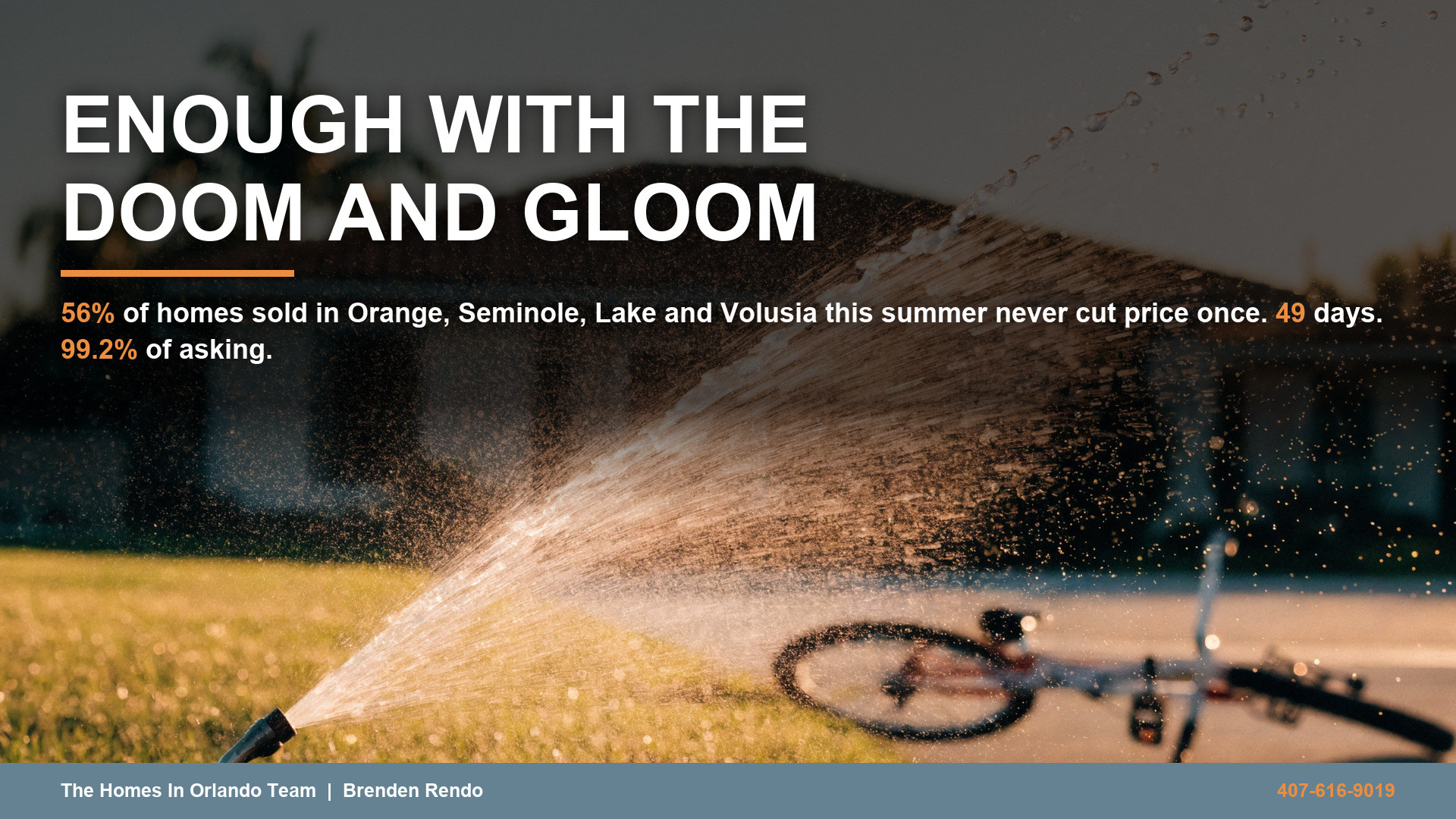
- What is actually happening is ordinary: 56.0% of sales this summer never cut price at all and closed in 49 days at 99.2% of ask. The homes priced to 2022 comparables sat, then discounted, then sat some more.
- My honest call is not a rebound either. Flat sales and flat appreciation, for years rather than quarters, until borrowing gets cheaper or wages catch up.
- What a crash actually looks like, and what showed up instead
- More than half of this summer sold at basically full price
- Inventory is high because homes sit, not because sellers fled
- Where the pain is real: older condos
- The insurance story you are being told is two years old
- People are still moving here, and they arrive with money
- So what is it, then? Flat. And I mean flat for years.
- What to actually do about it
- Common questions
- The line I would give you
What a crash actually looks like, and what showed up instead
A housing crash is not a mood. It leaves fingerprints, and there are three of them. Buyers walking away entirely, so volume collapses. A wave of new listings as everyone tries to get out at once. And prices falling as sellers take whatever they can get.
Check them one at a time against Greater Orlando this summer.
Collapsing volume. Sales did not collapse. They rose. July 2026 closed 3,568 sales against 3,363 in July 2025, up 6.1%.
Sellers rushing the exits. New listings brought to market in July 2026 came to 4,833, against 4,846 in July 2025. Down 0.3%. That is a rounding error, not an exodus.
Prices in free fall. The typical seller across the whole market achieved 96.5% of their original asking price. Last year in the same window it was 95.9%. Sellers are doing very slightly better than they were, not worse.
Three fingerprints. None of them present. What is left when you take the crash story away is a market that is behaving the way markets behave when they are working.
More than half of this summer sold at basically full price
Here is the number I wish led every story about this market. I split all 10,795 sales by whether the seller ever cut their asking price:
| What the seller did | Share of sales | Median days, list to close | Median share of original ask achieved |
|---|---|---|---|
| Never cut the price | 56.0% (6,043 sales) | 49 days | 99.2% |
| Cut 1% to 5% | 21.4% (2,312) | 102 days | 95.4% |
| Cut 5% to 10% | 13.0% (1,402) | 133 days | 90.8% |
| Cut 10% or more | 9.6% (1,038) | 193 days | 82.3% |
Source: first-party pull from the Stellar MLS feed, run August 27 and 28, 2026. Residential property in Orange, Seminole, Lake and Volusia counties, closings May 1 to July 31, 2026.
Read the top row and the bottom row against each other. The seller who priced it right was done in seven weeks with 99.2% of their money. The seller who had to chase the market down gave up roughly 17 percentage points of price and spent close to four times as long doing it. Same market. Same week. Same counties.
That is not a crashing market. That is a market that has stopped paying for optimism. And it punishes exactly one behavior, which is starting at a 2022 number.
Inventory is high because homes sit, not because sellers fled
There are 13,449 active residential listings across the four counties as I write this, and that number gets waved around as proof of collapse. It is not. New listings are flat year over year and sales are up 6.1%. The pile built because homes are sitting, not because more are arriving.
43.3% of everything currently on the market has been listed for 60 days or more. That is a pricing backlog. It clears slowly and unglamorously: some sellers reprice and trade, and some simply withdraw unsold rather than take the number. It does not clear in a dramatic wave, because there is no lender forcing anybody's hand.
For a buyer this is genuine leverage, and I track it weekly on the Central Florida Buyer Leverage Index. With 13,449 choices, nobody has to stretch. If a home is priced 5% over the market, buyers go look at the one next door. That is the entire mechanism behind every number on this page.
Where the pain is real: older condos
I am not going to tell you nothing hurts. Something does, and it is specific rather than general.
| Property type | Share sold below original ask | Median discount | Median share of original ask achieved |
|---|---|---|---|
| Condominiums (1,018 sales) | 88.8% | 8.8% | 92.2% |
| Single-family houses (8,311) | 70.7% | 5.3% | 97.0% |
| Townhouses and villas (1,034) | 74.5% | 4.9% | 96.8% |
Nearly nine in ten condo sales closed below the original ask, at roughly double the discount a house takes. Active condos sit a median of 101 days against 70 days for single-family homes, and 65.4% of active condos have been listed 60 days or more.
The driver is the structural reserve funding requirements brought in after Surfside, which have landed special assessments on a lot of older buildings. I want to be precise here because it gets blurred constantly: this is association assessment and reserve cost. It is not the owner's own insurance premium. An owner facing a five-figure assessment on a modest unit very often decides to sell rather than pay it, and the buyer looking at that unit prices the assessment in. That is a real, ongoing, building-by-building problem. It is also not the same thing as a market crash, and treating one as evidence of the other is how people talk themselves out of good decisions.
The insurance story you are being told is two years old
If a piece about this market mentions Florida insurance, it almost always reaches for the crisis framing. That framing is roughly two years stale. Insurance is now the one major cost line moving in the homeowner's favor.
I can give you this one first-hand. In the past month I cut the premium on my own home by more than USD 1,600 a year. Same house, same coverage, same roof. I shopped the policy properly and got my wind mitigation report updated. The saving came entirely from competition and from documenting the risk correctly.
That was possible because there are carriers to shop between again. From the Florida Office of Insurance Regulation July 2026 reporting:
- 21 new companies approved to write residential property insurance in Florida since the 2022 and 2023 litigation reforms.
- Since 2024, 44 insurers have filed for rate decreases and another 48 filed for no change at all.
- Average premiums including wind coverage fell in 51 of Florida's 67 counties.
- Citizens, the state-backed insurer of last resort, took an approved average cut of 8.8% on multiperil and 5.5% on wind-only from July 1, 2026. Largest reduction in its 24-year history.
- Citizens has shrunk from roughly 1.4 million policies at the peak to under 300,000 by mid-2026 as private carriers took the risk back.
- The underlying mechanism is boring, which is usually what a real fix looks like. Florida's share of all United States homeowners insurance lawsuits fell from 79% in 2020 to 41% in 2025.
Two caveats I will print right alongside that, because they matter. First, an approved rate cut is permission to charge less, not a promise to charge you less. Your actual bill is decided by underwriting: roof age and material, wind mitigation credits, claims history, elevation. Plenty of owners have seen no change because they never shopped and never updated their documentation. That gap is exactly where my own USD 1,600 was sitting. Second, this relief is reaching single-family homeowners far more than condo owners, and none of it touches the association reserve assessments in the section above.
Here is why this matters to the crash argument rather than being a side note. Insurance was supposed to be the thing driving Florida owners out. It has measurably eased, and the market stayed flat anyway. Which tells you insurance was never the binding constraint.
People are still moving here, and they arrive with money
If people were fleeing, you would expect collapsing prices and a wave of listings. You have neither. What you have is continued arrival.
More than 200,000 people from other states switched their driver's license to Florida in the first half of 2026 alone, the highest since 2023, per the Florida Department of Highway Safety and Motor Vehicles. The top states they left: New York (23,436), Georgia (12,699), New Jersey (11,831), California (11,076) and Texas (11,032). Orange County was the fourth largest receiving county in the state at 11,202, behind Miami-Dade, Palm Beach and Hillsborough.
Metro Orlando added 37,690 residents in the year to July 2025, the tenth largest numeric gain of any metro in the country and the fastest-growing region in the state. The people still arriving from other states earn more, skew older, and are more likely to already own a home than those leaving.
Two honest caveats. License swaps measure gross inflow, not net: they do not count people leaving, children, or non-drivers. And the statewide increase was modest, around 3% in the first half of 2026, concentrated in the southeast rather than spread evenly. But the direction is not in dispute, and it is not the direction a collapsing market has.
So what is it, then? Flat. And I mean flat for years.
I am not selling you a recovery either, and I want to be straight about that, because the opposite of doom is not hype.
My call is flat. Flat sales volume and flat appreciation, and not for a couple of quarters. I think this is a multi-year condition unless two things change: interest rate relief, and faster wage growth. Affordability here broke on both sides at once. Borrowing costs went up and stayed up, with the 30-year fixed at 6.66% on August 27 per the Freddie Mac Primary Mortgage Market Survey. And local incomes have not moved anywhere near fast enough to close the gap that opened in 2021 and 2022. A local wage does not reach a local house any more.
Nothing in that sentence gets fixed by a good spring selling season. It gets fixed by cheaper money or bigger paychecks. The two sections above are the proof of this rather than exceptions to it: insurance costs came down materially, people kept arriving at the second-fastest rate in the country, and the market stayed flat regardless. If carrying costs or fading demand were the constraint, the recovery would already be here.
What I expect instead is a market that grinds:
- Prices broadly flat, with the headline depending entirely on which county you pick. July median sale prices year over year: Seminole up 6.0%, Volusia up 3.0%, Orange down 1.3%, Lake down 2.5%. That spread is the story. There is no single Orlando price direction right now, let alone a single statewide one.
- Volume flat too. Sales are up 6.1%, but off a weak base. Without a rate move I expect transaction counts to settle roughly where they are.
- The gap between houses and older condos widens. Well-located single-family homes should keep trading in 45 to 60 days. Units in buildings with unfunded reserves have further to fall.
- Inventory clears slowly rather than dramatically. Sellers who will not reprice mostly exit unsold rather than discount.
- What would change my view: the 30-year moving meaningfully off 6.66% toward the high fives, plus wage growth genuinely outpacing living costs. That combination would tighten this market quickly, because the underlying demand is clearly there.
What to actually do about it
If you are selling. The entire outcome is decided in the first pricing conversation, and the table in section two is the whole argument. Priced to today's comparables you are looking at roughly seven weeks and something close to your asking price. Priced to what your neighbor got in 2022 you are looking at six months and a materially smaller check, and you will still end up at today's number, only later and from a weaker position. Waiting for the market to come get you is not a plan when my honest read is flat for years. Start with what your home is actually worth today using the home value estimator, then let me put real comparables against it.
If you are buying. You have 13,449 choices and 43.3% of them have been sitting 60 days or longer. That is the best negotiating position buyers have had here in four years, and it is quietly better than waiting for a price crash that the data says is not coming. Start with the homes that have already reduced: Orange County, Seminole County, Volusia County and Lake County.
If you own an older condo. Your situation is genuinely different from the rest of this page and deserves its own math. Find out where your building actually stands on reserve funding before you decide anything, because that single fact drives your value more than any market trend does.
Common questions
Is the Orlando housing market crashing in 2026?
No. Closed sales in July 2026 were up 6.1% over July 2025, and new listings were essentially flat at 4,833 against 4,846. Across 10,795 residential sales that closed in Orange, Seminole, Lake and Volusia counties between May 1 and July 31, 2026, the typical seller achieved 96.5% of the original asking price, against 95.9% in the same window last year. A crash produces collapsing volume and falling prices. Neither is present. The market is flat, not falling.
Why are so many Orlando homes sitting on the market?
Because of pricing, not because of a flood of sellers. New listings in July 2026 came to 4,833 against 4,846 in July 2025, essentially flat. The 13,449 active listings built up because homes are sitting, not because more are arriving. 43.3% of what is currently on the market has been listed 60 days or longer.
Do Orlando homes still sell at full price?
Yes, when they are priced correctly. 56.0% of everything that sold this summer sold without a single price reduction, in a median of 49 days, at 99.2% of the original asking price. Sellers who had to cut 10% or more took a median of 193 days and achieved 82.3% of original ask.
Is Florida homeowners insurance still driving sellers out?
That framing is roughly two years out of date. Per the Florida Office of Insurance Regulation, 21 new companies have been approved to write residential property insurance since the 2022 and 2023 reforms, average premiums including wind fell in 51 of Florida's 67 counties, and Citizens took an approved average cut of 8.8% on multiperil from July 1, 2026. The cost line still moving the wrong way is condominium association reserve assessments, which are separate from a homeowner's own premium.
The line I would give you
Greater Orlando is not falling apart, and it is not bouncing back either. It is done paying 2022 prices, and until borrowing gets cheaper or wages catch up, this is a flat market for years rather than months. The sellers who understand that are still selling in seven weeks at close to full ask, this month, in the same market everybody keeps calling a crash.
I run this analysis every week rather than pulling it once for a headline. The current numbers live on the Central Florida Market Pulse, the Buyer Leverage Index, and the monthly Central Florida housing market report, and they refresh every Sunday.
If you want to know what your specific home would do in this market instead of what the headlines say the market is doing, call or text me at 407-616-9019. I will bring the actual comparables and tell you the number straight, including when the answer is that you should wait.